
A Game Designer Won Stanford × DeepMind's Hackathon — Without Writing a Line of Code
Describe it, preview it on your phone, ship it.
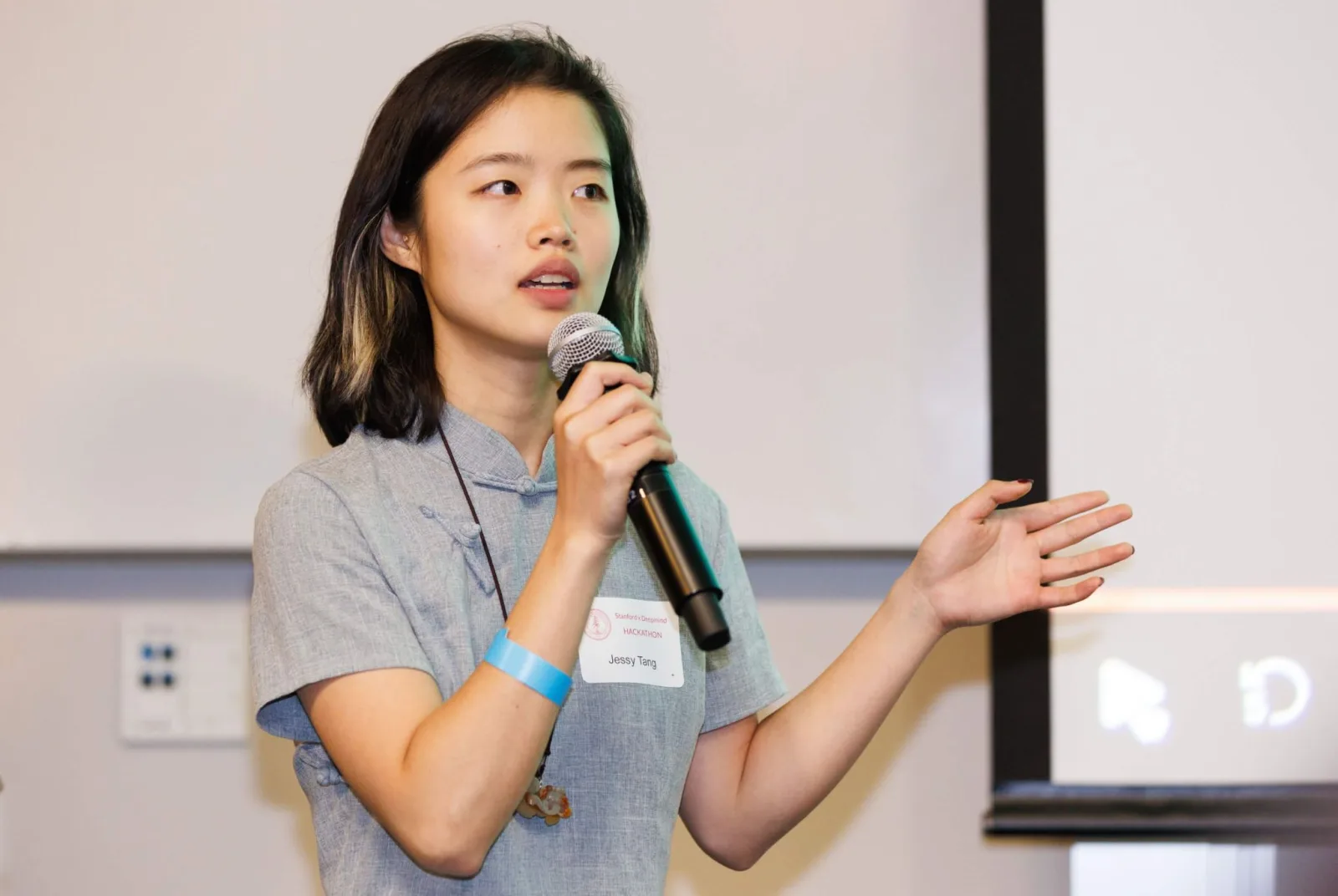
Start building free →Jessy Tang is a game designer. She holds a Master's degree in Game Design from the University of Utah, spent three years as a UE5 designer at Tencent IEG, and worked seven years as a multimedia artist before that. She has never written production code.
On April 12, 2026, she traveled from Salt Lake City to Stanford, entered the Stanford × DeepMind Hackathon solo, and over a 3-hour build sprint produced a working iOS and Android app called PinkedIn. The judging panel — 35+ VCs from NFX Bio, Felicis, SOSV, Threshold, Mighty Capital, AIX Ventures, and others, alongside Stanford faculty and Google DeepMind product leadership — awarded her 1st place.
The hackathon offered two tracks: Google AI Studio's Gemini codegen for web prototypes, and Fastshot for native mobile apps. Across both tracks, 3,412 signups produced 150+ working prototypes in the 3-hour window. Jessy chose the mobile track. Her app beat all of them.
What PinkedIn is
In Jessy's own words:
"PinkedIn turns your LinkedIn into a playable world — a Second Life for professional connections. Talk with virtual versions of real connections and get simulated reactions based on real data from their social interactions and posts."
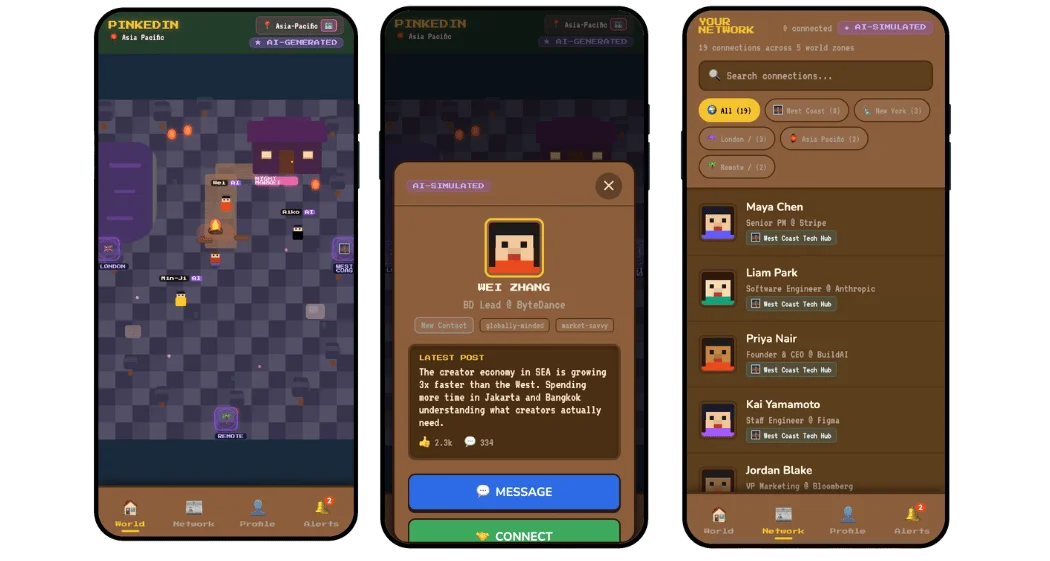
The concept only makes sense if you've spent your career building interactive worlds, which Jessy has. LinkedIn is a vast dataset of professional behavior — what people post, what they react to, what tone they use, who they connect with. That data sits mostly unused outside of recruiters running keyword searches on it. PinkedIn flips the orientation: the social graph becomes a game world you can walk around in. You can chat with a simulated version of a connection, and the responses are shaped by what that connection has actually posted and engaged with.
For someone whose professional life has been designing levels in Unreal Engine and configuring immersive interactive experiences, this isn't a stretch. It's the same skill — building a world that responds to a player — applied to a different kind of underlying data. The interesting part isn't the concept. The interesting part is the build.
How a designer ships a working iOS and Android app in 3 hours
The four-part description Jessy gave on her own LinkedIn post says it cleaner than any reframe:
"🥇 1st Place at the Stanford x DeepMind Hackathon — PinkedIn. I'm usually not a fan of posting but: Non-tech background + Solo builder + 3-hour sprint + Stanford On-campus was crazy fun!"
Non-tech background. Solo builder. 3-hour sprint. Stanford on-campus. Three years ago, this combination would have been impossible — designing a working iOS and Android app required either a developer or months of self-taught coding, and 3 hours wasn't enough time for either. What changed is the layer between idea and shipped app.
Jessy used Fastshot, an AI mobile app builder that generates React Native code from natural-language descriptions. The workflow looks like this: you describe what you want the app to do, the AI produces a working version, you preview it on your real phone via Expo Go, and you iterate by chatting until the app matches what you had in your head. There's no coding step. You can read or edit the generated code if you want to, but you don't have to.
That's the workflow Jessy used to build PinkedIn. The skill that matters isn't writing code — it's describing what you want clearly enough that the AI can produce it, then iterating until the result matches your vision. That's a designer's job. It's literally the work designers have been doing their entire careers, just applied to a different medium. The bottleneck shifted from "can you code" to "can you describe what you want," and Jessy's answer to the second question was, evidently, yes.
The tool is one half of the explanation. The other half is Jessy's specific background — seven years of multimedia design, three years at Tencent IEG, Unreal Engine 5 Level Design certification, a Master's degree in game design. She wasn't a generic non-developer. She was a non-developer with a decade of experience translating ideas into interactive systems. When the medium changed from game engines to AI builders, the underlying skill transferred cleanly.
Why this matters for designers and solo creators
The category of person who could ship a winning hackathon app in 3 hours used to be very narrow: senior software engineers with strong product instincts. That's a small population, and the population is mostly already employed at well-funded companies. The category just got bigger.
Designers who've spent careers thinking about user experience but couldn't write code now can ship. Product managers who've shipped through engineering teams now can prototype directly. Operators who understand a business problem deeply enough to know what the solution should feel like now can build the solution themselves, see it on their phone, iterate, and demo it. None of this requires learning to code. It requires being able to describe what you want — which most experienced product thinkers already can.
What this hackathon showed is that when those two populations meet — strong product judgment + AI builders that ship to native code — they can outperform teams of engineers in a head-to-head, time-boxed competition. Jessy didn't win because she had the most engineering firepower in the room. She won because her product instincts were sharper, and her tool was good enough that the gap between instinct and shipped app collapsed from months to hours.
For anyone in a similar position — designers wondering if they should learn to code, founders waiting on engineering bandwidth, solo creators sitting on ideas — that compression is the news. The path from idea to working mobile app is dramatically shorter than it was a year ago, and the bottleneck has moved from coding skill to clarity of vision.
The same hackathon, the same tool, a different kind of winner
Jessy wasn't the only Fastshot-built app in the top 6 at this hackathon. The 2nd place team came from a completely different starting point — an established AI SaaS startup that used the same three-hour window to ship a consumer mobile app on top of their existing B2B platform. That story is here →
The 6th place team (LY-Links / MoodFeed) was also built on Fastshot — a mood-based content recommendation app, also shipped in three hours, also from a small team. Three of the top six placements on the same tool, used by three completely different kinds of builder.
Build the thing you've been thinking about
You can open PinkedIn right now and walk through what Jessy built in 3 hours. Then build your own.
The hardest part isn't the building anymore. The hardest part is being clear about what you actually want.
→ Start building with Fastshot
For the deeper picture — what the AI generates, how the workflow runs, where it still benefits from human judgment — the how to build a mobile app with AI guide walks through the full workflow. If you've been looking at Lovable for mobile apps, the breakdown of why Lovable doesn't build native mobile (and what to use instead) is also worth reading.
Build it, don't just read about it
Describe the app you want and Fastshot generates real React Native code you can preview on your phone and ship to the App Store. No credit card to start.
Build my mobile app →