
Mobile Storefront vs Mobile Companion - The Tapcart Question
Describe it, preview it on your phone, ship it.
Start building free →If you've evaluated mobile apps for your Shopify store in the last two years, you've probably looked at Tapcart, Fuego, or one of the half-dozen storefront-app builders that wrap your catalog in native chrome and call it a day. The pitch is reasonable: your store becomes an app, push notifications replace some of your email volume, conversion rates go up because the experience is faster than mobile Safari.
That's all true. And it's also where most of those projects plateau. The push notifications drive a temporary lift, the install base grows for a few months, and then the curve flattens because the underlying product hasn't changed — the app is still a place to buy things, and the customer's relationship with your brand is still transactional.
We talk to a lot of founders who are either skeptical of mobile apps because they tried this and saw it level off, or who currently have a Tapcart-style setup and aren't sure why the retention story isn't working. Here's the distinction nobody draws clearly enough.
A mobile storefront sells. A mobile companion makes the product part of the user's day.
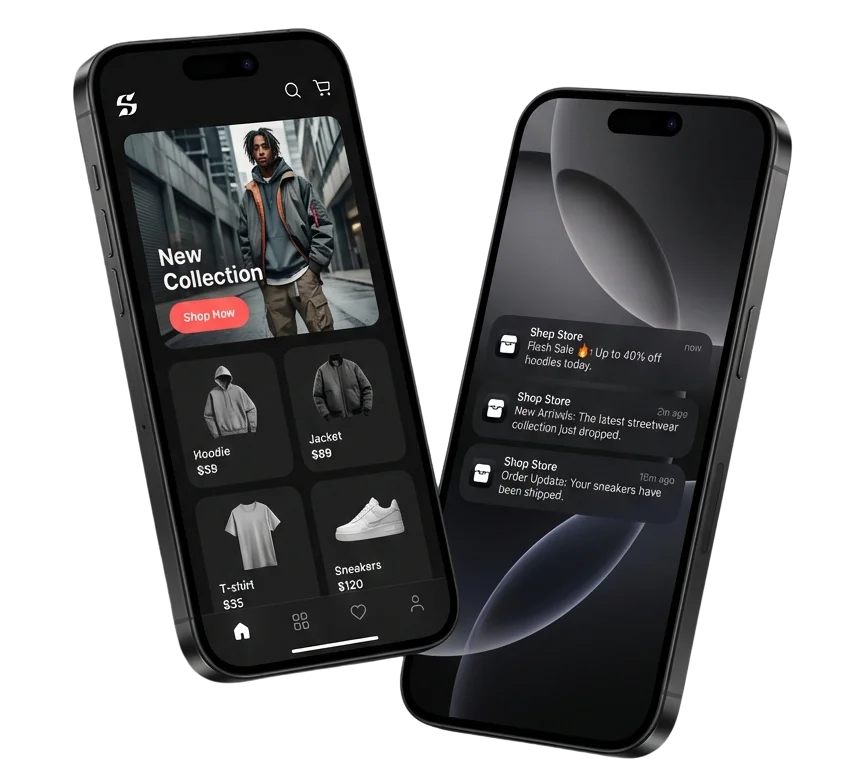
A storefront app is a checkout interface with an icon. The user opens it when they want to buy something. Push notifications drive them back to the catalog. The retention gain comes from being one tap closer to a transaction.
A companion app is an interface to the product they already bought. The user opens it because the product is part of their routine — they're checking in, tracking progress, getting reminded, learning what to do next. Reorders happen as a byproduct of consistent use, not as a direct response to a "30% off" notification.
These are different products with different metrics. A storefront app is judged on push CTR, install-to-purchase conversion, and revenue per user. A companion app is judged on session frequency, day-30 retention, streak length, and adherence. The first set of metrics rewards you for shopping behavior. The second rewards you for usage behavior.
Why this distinction matters for the brands the storefront model leaves behind
The storefront app model works best for catalogs people browse — apparel, accessories, home goods, gifts. The user has 50 things they might buy. Showing them new arrivals and personalized recommendations is the whole game.
The model gets weak fast for products people don't browse, they use. Supplements, skincare, fitness equipment, specialty food, anything with a regimen or a ritual. There's nothing to browse. The customer bought one thing, and the question that determines whether they come back is whether they used it consistently enough to want more.
For these brands, a storefront app is solving a problem they don't have. Their customers aren't friction-blocked at checkout — they're friction-blocked at consistent daily use. Adding a faster checkout doesn't help. Adding a daily-use surface does.
The Tapcart case, specifically
Tapcart is genuinely good at what it does. The team has shipped a polished product that turns a Shopify store into a usable mobile app in a weekend. If you're a fashion brand or an accessories brand and your retention loop is "send a push when new product drops," Tapcart will probably do that better than building it yourself.
Where it falls short — and we're not the only ones saying this — is when your retention loop requires features that aren't in the templated builder. A workout tracker. A recipe calendar. An adherence dashboard. A photo log for skincare progress. These aren't drag-and-drop widgets. They're product-specific features that only make sense in the context of what your customer is actually doing with what they bought.
The Tapcart team has been clear about their scope. They build storefronts. The companion-app category is a different product, and trying to retrofit it onto a templated framework is the wrong shape — you end up either with constraints that don't fit your use case, or with a Frankenstein of native code that defeats the purpose of the platform.
What a companion app actually does
The shape of a companion is something like this:
It opens to the user's current state, not your catalog. If they're in week 3 of a supplement protocol, they see their adherence streak, the next dose timing, and any check-in question you've configured. Not a product carousel.
It captures usage. Photo logs, check-ins, weight or measurement entry, task completions — whatever data is meaningful for the product's effect to be measurable. This is the source of the leading indicator that lets you intervene before retention collapses.
It nudges, but contextually. Not "we miss you, here's 20% off." Something like "you've logged 12 workouts this month. The plan increases intensity in week 4." The nudge is about the usage, not about the purchase, and the purchase becomes a downstream consequence.
It triggers reorders on actual depletion. If you know how much product the user has consumed because they've been logging it, you can send the replenishment trigger when it's actually empty rather than on a calendar guess.
The result is an app the user opens 4–8 times per week instead of once a quarter when a sale notification fires. That session frequency is what compounds into retention.
Custom code, not a templated builder
Building this used to mean either an in-house mobile team or a $150k–250k agency engagement. The economics didn't work for sub-$10M brands and the ones who tried it usually shelved the project after six months.
The reason Fastshot exists in this category is that AI-generated code closes the gap. The companion app is generated from a description of your product, your category, and the ritual you want to support. The output is a real React Native + Expo project — not a template, not a wrapper — integrated with your Shopify backend through the standard storefront and admin APIs.
When you need to change a feature, you describe the change. There's no design sprint, no engineering ticket, no two-week release cycle. The same constraint that made companion apps unaffordable for most brands — that every brand needs custom features — is the constraint AI generation removes.
The decision tree
If your retention story works on "we drop new products and customers come browse" — a storefront app like Tapcart is probably the right tool. The model fits.
If your retention story requires customers to use the product consistently over weeks or months for it to work — a storefront app is solving the wrong problem. You need a companion. The good news is the cost to find out has dropped to roughly the cost of a month of paid media.
Build it, don't just read about it
Describe the app you want and Fastshot generates real React Native code you can preview on your phone and ship to the App Store. No credit card to start.
Build my mobile app →